![]() |
![]() |
![]() |
|
|
About Us | Education | The Arts | Newsletters | Research | Links | Archives |
|
|
Bruce
Duncan
Memorial Lecture Series All lectures will be now held at the former Parks Canada Discovery Centre now administered by the
Hamilton Waterfront Trust The 8th Series 2012 Memorial Lecture Series Schedule 57 Discovery Drive |
The
Giant’s
Rib
Discovery Centre is a
not-for-profit organization created to tell the story of the
Niagara Escarpment, and promote uses that will ensure retention of its
natural state for future generations. We offer public educational
lectures and tours to interpret the Niagara Escarpment through
geographical, geological,
historical, agricultural, and cultural experiences.
Looking
for Information
about the Niagara Escarpment ?
|
May 2012 Newsletter![]() |
|
![]() [ email tickets@giantsrib.ca to get your tickets ] More info can be found here: |
|
![]() Giant’s Rib Discovery Centre Calls for Volunteers Volunteer positions are available with the Giant’s Rib Discovery Centre. We are looking for individuals available for morning (9:30 – 12:30) and afternoon (12:30-3:30) shifts at the Trail Centre in the Dundas Valley Conservation Area on Governor’s Road in Dundas. Volunteers are also needed to assist with fundraising events, public programs and Board positions |
|
![]() The GRDC is seeking individuals who have an interest preserving, enjoying and educating the public on the Niagara Escarpment, a UNESCO World Biosphere Reserve. Even if you are not experienced but have an interest in the Escarpment and want to learn more, volunteering with us is an excellent opportunity to learn. The Centre hosts an Arts and Photography Series (featuring a local artist of the month) on Saturdays and Sundays, holds a lecture series one Sunday per month, and is looking to expand our public programs. The Giant’s Rib Discovery Centre (GRDC) is all about the Niagara Escarpment... otherwise known as “The Giant’s Rib”. We are a not-for-profit organization created to tell the story of the Niagara Escarpment, and promote uses that will ensure retention of its natural state for future generations. We offer public educational lectures and tours to interpret the Niagara Escarpment through geographical, geological, historical, agricultural, and cultural experiences. If you are available to volunteer or know someone who is, please email Ken Hall or call 905-627-1320. |
|
|
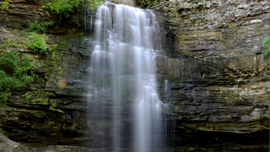
Waterfall of the Month for May 2012 Jones Rd. Falls
Jones Rd. Falls (or Jones Road Falls) is located in the Stoney Creek section of Hamilton opposite the end of Jones Rd., near the top of the Niagara Escarpment, above the Bruce Trail and below the CN railway tracks. It appears that when the railway tracks were built along the side of the Niagara Escarpment, a creek or water flow on top of the escarpment was diverted into a pipe which pours into a large concrete structure on the south side of the tracks. From this structure the water then flows through another pipe, which runs diagonally westward under the railway tracks and exits about 50m to the west on the north side of the tracks. The pipe outlets at a 45 degree angle beside a vertical stone wall which deflects the water down the escarpment. Jones Rd. Falls is considered a Terraced Ribbon Cascade with a height of 6 m (20 ft.) and a width of 2m (7 ft.). It is dry much of the year with flow only after rainfalls and during the winter snow melt. To reach this waterfall from the QEW, take the Fruitland Rd. exit, go south to Hwy #8, turn left and proceed to Jones Rd. Turn right and go to the end of Jones Rd. just below the Niagara Escarpment. Park on the shoulder and follow the Jones Rd. Side Trail up the escarpment to the Bruce Trail. Then follow the ravine at this location up the escarpment to the waterfall. ![]() |
|
|
THE NIAGARA ESCARPMENT WORLD BIOSPHERE RESERVE
The Directors of the
Giant’s Rib Discovery Centre form a Committee of the Niagara Escarpment
World Biosphere Reserve. Their basic responsibilities are directed to
helping ensure that the Niagara Escarpment continues to meet the
three basic criteria of a biosphere reserve:
Contribute to conservation of landscapes, ecosystems, species and genetic variation; Foster economic and human development which is socio-culturally and ecologically sustainable; Provide support for research, monitoring, education and information exchange related to local national and global issues of conservation and development.
GIANT’S RIB RECEIVES RECOGNITION
Richard Murzin,
President of the Canadian Biosphere Reserves Association, announced on
Thursday, June 21, 2007 that the Giant’s Rib Discovery Centre (GRDC) has
been recognized as a local biosphere committee for the Niagara
Escarpment Biosphere Reserve.
The Association considers that the Giant’s Rib is already fulfilling many activities for the Niagara Escarpment, which reflect the Escarpment’s designation as a UNESCO World Biosphere Reserve. They are pleased to acknowledge this and to thank the GRDC for their support for research, education, training and encouragement for sustainable development related to the Niagara Escarpment. A biosphere reserve draws its strength from active involvement and cooperation within a community of interest. The GRDC is exemplary in this regard and the Niagara Escarpment Biosphere Reserve is honoured to recognize the Giant’s Rib Discovery Centre as a biosphere committee.
The UNESCO Biosphere Reserve Designation
The biosphere is all of the land, water and atmosphere that support life
A biosphere reserve
is an international designation of recognition from UNESCO (the United
Nations Educational, Scientific, and Cultural Organization) for an
area in the world which is deemed to demonstrate a balanced
relationship between humans and the biosphere. By this is meant that
collaborative efforts among people in the designated area serve to
promote the sustainability of local economies and communities, as well
as the conservation of the terrestrial/or coastal ecosystems they are
in.
A biosphere reserve designation gives an area international recognition for the important ecological and cultural values in an area. It also provides a mechanism, based on local commitment and local ability, to apply sound stewardship (and protection, where necessary) to use of resources in an area to support present and future generations. UNESCO named Ontario’s Niagara Escarpment a world biosphere reserve in February 1990. Ontario’s Niagara Escarpment is one of 16 reserves in Canada and is part of a network of 580 reserves in 114 countries. The Niagara Escarpment Biosphere Reserve conserves the Province of Ontario’s natural and social capital by protecting prime agricultural lands, forests, wetlands, heritage properties and recreational spaces. Biosphere Reserves strive to conserve the diversity of plants, animals and micro- organisms which make up our living biosphere and maintain healthy natural systems while, at the same time meeting the material needs and aspirations of an increasing number of people. Before UNESCO designates a biosphere reserve, local people and organizations must have demonstrated their commitment to these principles.
CANADA’S BIOSPHERE RESERVES
The sixteen biosphere
reserves in Canada are located in eight provinces, from the Atlantic to
the Pacific coasts. They include a variety of ecosystems. In each one,
activities are coordinated by a community- based organization or
committee. Beginning with its first reserve in the 1970s, Canada’s
biosphere reserves were established as follows:
|
|
|
![]() |
Check out our Facebook page for latest news and new photos from the Giant's Rib !!
| |
About Us |
Education |
The Arts | Newsletters |
Research |
Links |
Archives The
Giant’s Rib
Discovery
Centre Box 1469, Waterdown, ON, L0R 2H0Visit the Centre's displays and presentations at the Trail Centre, Dundas Conservation 650 Governors Road Dundas Ontario ©
www.giantsrib.ca 2012
|
|